

Part C: ParaDiag in pySDC#
Here we leave the hand-written linear algebra behind and set ParaDiag up through pySDC’s controllers, comparing it with single-level PFASST in Jacobi mode and with serial time stepping. In PFASST, we use a diagonal preconditioner, which allows for the same amount of parallelism as ParaDiag. We show iteration counts per step, but both schemes have further concurrency across the nodes.
Two examples: a linear advection problem, discretized with finite differences, and the nonlinear van der Pol
oscillator, with mu chosen such that the problem is not overly stiff. Neither setup is optimized: with a
different choice of \(\alpha\) in ParaDiag, or with inexactness and coarsening in PFASST, both schemes could be
improved significantly. This is not meant to show that one parallelization scheme is better than the other. It
does show that both, without optimization, need fewer iterations per task than serial time stepping. Kindly refrain
from computing parallel efficiency from these numbers, though. ;)
The setups#
ParaDiag needs its own sweeper, QDiagonalization, and its own controller, controller_ParaDiag_nonMPI. Its
controller parameters set \(\alpha\), and whether to average the Jacobian (for the nonlinear problem only, as it
costs communication).
import matplotlib.pyplot as plt
import numpy as np

from pySDC.helpers.stats_helper import get_sorted


def get_description(problem='advection', mode='ParaDiag'):
    level_params = {}
    level_params['dt'] = 0.1
    level_params['restol'] = 1e-6

    sweeper_params = {}
    sweeper_params['quad_type'] = 'RADAU-RIGHT'
    sweeper_params['num_nodes'] = 3
    sweeper_params['initial_guess'] = 'copy'

    if mode == 'ParaDiag':
        from pySDC.implementations.sweeper_classes.ParaDiagSweepers import QDiagonalization as sweeper_class

        # we only want to use the averaged Jacobian and do only one Newton iteration per ParaDiag iteration!
    else:
        from pySDC.implementations.sweeper_classes.generic_implicit import generic_implicit as sweeper_class

        # need diagonal preconditioner for same concurrency as ParaDiag
        sweeper_params['QI'] = 'MIN-SR-S'

    if problem == 'advection':
        from pySDC.implementations.problem_classes.AdvectionEquation_ND_FD import advectionNd as problem_class

        problem_params = {'nvars': 64, 'order': 8, 'c': 1, 'solver_type': 'GMRES', 'lintol': 1e-8}
    elif problem == 'vdp':
        from pySDC.implementations.problem_classes.Van_der_Pol_implicit import vanderpol as problem_class

        # need to not raise an error when Newton has not converged because we do only one iteration
        problem_params = {'newton_maxiter': 99, 'crash_at_maxiter': False, 'mu': 1, 'newton_tol': 1e-9}

    step_params = {}
    step_params['maxiter'] = 99

    description = {}
    description['problem_class'] = problem_class
    description['problem_params'] = problem_params
    description['sweeper_class'] = sweeper_class
    description['sweeper_params'] = sweeper_params
    description['level_params'] = level_params
    description['step_params'] = step_params

    return description


def get_controller_params(problem='advection', mode='ParaDiag'):
    from pySDC.implementations.hooks.log_errors import LogGlobalErrorPostRun
    from pySDC.implementations.hooks.log_work import LogWork, LogSDCIterations

    controller_params = {}
    controller_params['logger_level'] = 30
    controller_params['hook_class'] = [LogGlobalErrorPostRun, LogWork, LogSDCIterations]

    if mode == 'ParaDiag':
        controller_params['alpha'] = 1e-4

        # For nonlinear problems, we need to communicate the average solution, which allows to compute the average
        # Jacobian locally. For linear problems, we do not want the extra communication.
        if problem == 'advection':
            controller_params['average_jacobian'] = False
        elif problem == 'vdp':
            controller_params['average_jacobian'] = True
    else:
        # We do Block-Jacobi multi-step SDC here. It's a bit silly but it's better for comparing "speedup"
        controller_params['mssdc_jac'] = True

    return controller_params


def run_problem(
    n_steps=4,
    problem='advection',
    mode='ParaDiag',
):
    if mode == 'ParaDiag':
        from pySDC.implementations.controller_classes.controller_ParaDiag_nonMPI import (
            controller_ParaDiag_nonMPI as controller_class,
        )
    else:
        from pySDC.implementations.controller_classes.controller_nonMPI import controller_nonMPI as controller_class

    if mode == 'serial':
        num_procs = 1
    else:
        num_procs = n_steps

    description = get_description(problem, mode)
    controller_params = get_controller_params(problem, mode)

    controller = controller_class(num_procs=num_procs, description=description, controller_params=controller_params)

    for S in controller.MS:
        S.levels[0].prob.init = tuple([*S.levels[0].prob.init[:2]] + [np.dtype('complex128')])

    P = controller.MS[0].levels[0].prob

    t0 = 0.0
    uinit = P.u_exact(t0)

    uend, stats = controller.run(u0=uinit, t0=t0, Tend=n_steps * controller.MS[0].levels[0].dt)
    return uend, stats
The solution becomes complex, because the diagonalization is: run_problem switches the data type of the problems
to complex numbers before the run.
The comparison#
ParaDiag, PFASST in Jacobi mode and serial time stepping, for 16 steps. Besides the iterations, we compare the work of the inner solvers: GMRES iterations for advection, Jacobian solves for van der Pol.
def compare_ParaDiag_and_PFASST(n_steps, problem):
    print(f'Running {problem} with {n_steps} steps')

    uend_PD, stats_PD = run_problem(n_steps, problem, mode='ParaDiag')
    uend_PF, stats_PF = run_problem(n_steps, problem, mode='PFASST')
    uend_S, stats_S = run_problem(n_steps, problem, mode='serial')

    assert np.allclose(uend_PD, uend_PF)
    assert np.allclose(uend_S, uend_PD)
    assert (
        abs(uend_PD - uend_PF) > 0
    )  # two different iterative methods should not give identical results for non-zero tolerance

    k_PD = get_sorted(stats_PD, type='k')
    k_PF = get_sorted(stats_PF, type='k')

    print(
        f'Needed {max(me[1] for me in k_PD)} ParaDiag iterations and {max(me[1] for me in k_PF)} single-level PFASST iterations'
    )
    if problem == 'advection':
        k_GMRES_PD = get_sorted(stats_PD, type='work_GMRES')
        k_GMRES_PF = get_sorted(stats_PF, type='work_GMRES')
        k_GMRES_S = get_sorted(stats_S, type='work_GMRES')
        print(
            f'Maximum GMRES iterations on each step: {max(me[1] for me in k_GMRES_PD)} in ParaDiag, {max(me[1] for me in k_GMRES_PF)} in single-level PFASST and {sum(me[1] for me in k_GMRES_S)} total GMRES iterations in serial'
        )
    elif problem == 'vdp':
        k_Jac_PD = get_sorted(stats_PD, type='work_jacobian_solves')
        k_Jac_PF = get_sorted(stats_PF, type='work_jacobian_solves')
        k_Jac_S = get_sorted(stats_S, type='work_jacobian_solves')
        print(
            f'Maximum Jacobian solves on each step: {max(me[1] for me in k_Jac_PD)} in ParaDiag, {max(me[1] for me in k_Jac_PF)} in single-level PFASST and {sum(me[1] for me in k_Jac_S)} total Jacobian solves in serial'
        )
    print()
    return max(me[1] for me in k_PD), max(me[1] for me in k_PF)
iterations = {problem: compare_ParaDiag_and_PFASST(n_steps=16, problem=problem) for problem in ['advection', 'vdp']}
Running advection with 16 steps
Needed 3 ParaDiag iterations and 35 single-level PFASST iterations
Maximum GMRES iterations on each step: 94 in ParaDiag, 861 in single-level PFASST and 1951 total GMRES iterations in serial

Running vdp with 16 steps
Needed 10 ParaDiag iterations and 24 single-level PFASST iterations
Maximum Jacobian solves on each step: 30 in ParaDiag, 143 in single-level PFASST and 233 total Jacobian solves in serial
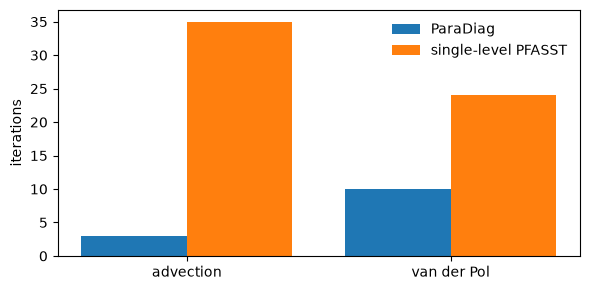
ParaDiag converges in very few iterations for the hyperbolic advection problem (3), where PFASST struggles (36). For van der Pol, ParaDiag needs fewer iterations as well (10 against 24), with a much smaller margin. Remember that ParaDiag does only one Newton iteration per ParaDiag iteration, so per node, its number of Newton iterations equals the number of ParaDiag iterations, while PFASST solves the systems to some accuracy in every iteration. That makes the difference in Jacobian solves per step much larger than the one in iterations: 30 against 143. Again, inexactness could improve PFASST.
Important things to note
ParaDiag needs its own sweeper (
QDiagonalization) and its own controller.The solution becomes complex, because the diagonalization is.
ParaDiag converges in very few iterations for the hyperbolic advection example, where PFASST struggles. For the van der Pol oscillator, the gap in iterations is much smaller.
The checks the tests run are inside compare_ParaDiag_and_PFASST: all three methods agree, and the two iterative
ones are not identical.