

Part C: SDC vs. MLSDC#
Now we run multilevel SDC and compare it with SDC, for one step of the unforced heat equation. Two descriptions, two controllers: SDC on one level, MLSDC on three, coarsened in space and in the number of collocation nodes.
import matplotlib.pyplot as plt

from pySDC.helpers.stats_helper import get_sorted
from pySDC.implementations.controller_classes.controller_nonMPI import controller_nonMPI
from pySDC.implementations.problem_classes.HeatEquation_ND_FD import heatNd_unforced
from pySDC.implementations.sweeper_classes.generic_implicit import generic_implicit
from pySDC.implementations.transfer_classes.TransferMesh import mesh_to_mesh

# initialize level parameters
level_params = {'restol': 1e-09, 'dt': 0.1}

# initialize sweeper parameters
sweeper_params_sdc = {'node_type': 'LEGENDRE', 'quad_type': 'RADAU-RIGHT', 'num_nodes': 5, 'QI': 'LU'}
sweeper_params_mlsdc = {'node_type': 'LEGENDRE', 'quad_type': 'RADAU-RIGHT', 'num_nodes': [5, 3, 2], 'QI': 'LU'}

# initialize problem parameters
problem_params_sdc = {
    'nu': 0.1,  # diffusion coefficient
    'freq': 4,  # frequency for the test value
    'nvars': 1023,  # number of degrees of freedom
    'bc': 'dirichlet-zero',  # boundary conditions
}
problem_params_mlsdc = {
    'nu': 0.1,  # diffusion coefficient
    'freq': 4,  # frequency for the test value
    'nvars': [1023, 511, 255],  # number of degrees of freedom for each level
    'bc': 'dirichlet-zero',  # boundary conditions
}

# initialize step parameters
step_params = {'maxiter': 20}

# initialize space transfer parameters
space_transfer_params = {'rorder': 2, 'iorder': 6}

# initialize controller parameters
controller_params = {'logger_level': 30}

# fill description dictionary for SDC
description_sdc = {
    'problem_class': heatNd_unforced,
    'problem_params': problem_params_sdc,
    'sweeper_class': generic_implicit,
    'sweeper_params': sweeper_params_sdc,
    'level_params': level_params,
    'step_params': step_params,
}

# fill description dictionary for MLSDC
description_mlsdc = {
    'problem_class': heatNd_unforced,
    'problem_params': problem_params_mlsdc,
    'sweeper_class': generic_implicit,
    'sweeper_params': sweeper_params_mlsdc,
    'level_params': level_params,
    'step_params': step_params,
    'space_transfer_class': mesh_to_mesh,
    'space_transfer_params': space_transfer_params,
}

# instantiate the controllers
controller_sdc = controller_nonMPI(num_procs=1, controller_params=controller_params, description=description_sdc)
controller_mlsdc = controller_nonMPI(num_procs=1, controller_params=controller_params, description=description_mlsdc)
To see what the two cost, we also count how often each level evaluates the right-hand side, by wrapping the
eval_f of each level’s problem in a counter:
def count_rhs_evaluations(controller):
    """Wrap eval_f of each level's problem, and return one counter per level"""
    counters = []
    for L in controller.MS[0].levels:
        counter, eval_f = [0], L.prob.eval_f

        def counting_eval_f(*args, eval_f=eval_f, counter=counter, **kwargs):
            counter[0] += 1
            return eval_f(*args, **kwargs)

        L.prob.eval_f = counting_eval_f
        counters.append(counter)
    return counters


rhs_sdc = count_rhs_evaluations(controller_sdc)
rhs_mlsdc = count_rhs_evaluations(controller_mlsdc)
Running both#
# set time parameters
t0 = 0.0
Tend = 0.1

# get initial values on finest level
P = controller_sdc.MS[0].levels[0].prob
uinit = P.u_exact(t0)

# call main functions to get things done...
uend_sdc, stats_sdc = controller_sdc.run(u0=uinit, t0=t0, Tend=Tend)
uend_mlsdc, stats_mlsdc = controller_mlsdc.run(u0=uinit, t0=t0, Tend=Tend)

# get number of iterations for both
niter_sdc = get_sorted(stats_sdc, type='niter', sortby='time')[0][1]
niter_mlsdc = get_sorted(stats_mlsdc, type='niter', sortby='time')[0][1]

# compute exact solution and compare both
uex = P.u_exact(Tend)
err_sdc = abs(uex - uend_sdc)
err_mlsdc = abs(uex - uend_mlsdc)
diff = abs(uend_mlsdc - uend_sdc)

print('Error SDC and MLSDC: %12.8e -- %12.8e' % (err_sdc, err_mlsdc))
print('Difference SDC vs. MLSDC: %12.8e' % diff)
print('Number of iterations SDC and MLSDC: %2i -- %2i' % (niter_sdc, niter_mlsdc))
print('Right-hand side evaluations per level, SDC and MLSDC:', [c[0] for c in rhs_sdc], [c[0] for c in rhs_mlsdc])
Error SDC and MLSDC: 3.96232005e-08 -- 3.95409344e-08
Difference SDC vs. MLSDC: 8.22683033e-11
Number of iterations SDC and MLSDC: 12 --  6
Right-hand side evaluations per level, SDC and MLSDC: [66] [66, 78, 30]
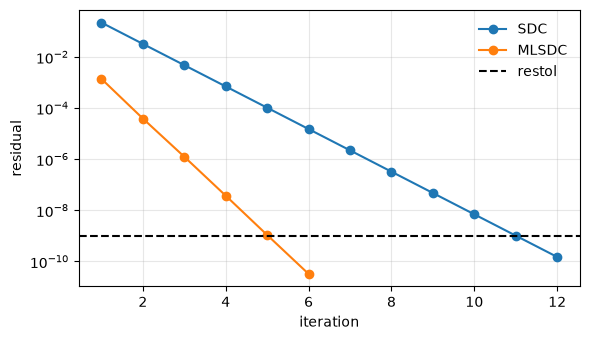
The same result, in half the iterations. This is the best case, and in many situations it cannot be achieved; in particular, the interpolation order is crucial.
The count tells the other half of the story: MLSDC evaluates the right-hand side on the finest level exactly as often as SDC, plus the evaluations on the coarse levels. After each coarse-level correction, the interpolated values need their right-hand side on the fine level again, before the next fine sweep. What halves with the iterations are the fine sweeps, and with them the implicit solves on the finest level; the fine right-hand side work does not drop at all.
Try it yourself
Interpolate the right-hand side too, instead of evaluating it again: add
description_mlsdc['base_transfer_params'] = {'finter': True}before the controllers are created, and run everything again.Switch on a predictor with the controller parameter
predict_type: the defaultNonehas none,'pfasst_burnin'sweeps on the coarsest level first. How many iterations does MLSDC need then? (The SDC controller warns that it ignores the predictor: it has only one level.)
Answers
The iterations and the result stay the same, but the finest level needs 36 evaluations instead of 66.
4 instead of 6. The result stays within the tolerance of SDC’s: the difference grows from \(8 \cdot 10^{-11}\) to \(2 \cdot 10^{-10}\). The predictor’s own sweeps do not count as iterations, though.
The checks the tests run:
assert diff < 6e-10, f"ERROR: difference between MLSDC and SDC is higher than expected, got {diff}"
assert niter_sdc - niter_mlsdc >= 6, f"ERROR: MLSDC required more iterations than expected, got {niter_mlsdc}"