

Part C: Iteration estimator#
When should SDC, MLSDC or PFASST stop iterating? So far, we stopped when the residual was small enough or after a fixed number of iterations. Another option is to estimate how many iterations it takes to get the error with respect to the exact collocation solution below a tolerance.
Two consecutive iterates give an estimate of the contraction factor of the iteration, \(\tilde L = \|u^{k} - u^{k-1}\| / \|u^{k-1} - u^{k-2}\|\). If the iteration contracts like this, the error after \(K\) iterations is at most \(\tilde L^K \|u^1 - u^0\| / (1 - \tilde L)\), which is below a tolerance \(\varepsilon\) once
Add a few magic safety constants (\(\tilde L\) is capped at 0.9, and \(K\) gets 5% more) and you can guess when to
stop. In pySDC, this is the convergence controller CheckIterationEstimatorNonMPI, with the tolerance as
errtol:
description['convergence_controllers'] = {CheckIterationEstimatorNonMPI: {'errtol': 1e-7}}
Checking it#
To see whether the estimator does its job, we need the error with respect to the exact collocation solution.
The hook error_output, in HookClass_error_output.py next to this tutorial, gets it with some black magic: before
each step, it runs pySDC once more inside the hook, without the estimator, and solves the collocation problem of
that step to a residual of \(10^{-14}\) or for 50 iterations, whichever comes first. After the step, it records the
error with respect to that and to the exact solution of the PDE. For this, the description and the controller
parameters are handed to the hook through the step parameters.
    def pre_step(self, step, level_number):
        """
        Default routine called before each step
        Args:
            step: the current step
            level_number: the current level number
        """
        super(error_output, self).pre_step(step, level_number)

        L = step.levels[level_number]

        # This is a bit black magic: we are going to run pySDC within the hook to check the error against the "exact"
        # solution of the collocation problem
        # copies: this hook runs in every step, and the outer run's parameters must stay as they are
        description = dict(step.params.description)
        description['level_params'] = {**description['level_params'], 'restol': 1e-14}
        if type(L.prob) != auzinger:
            description['problem_params'] = {**description['problem_params'], 'solver_type': 'direct'}
        # without this, the iteration estimator would stop the "exact" solve as early as the run it is checking
        description['convergence_controllers'] = {}

        controller_params = dict(step.params.controller_params)
        del controller_params['hook_class']  # get rid of the hook, otherwise this will be an endless recursion..
        controller_params['logger_level'] = 90

        controller = controller_nonMPI(num_procs=1, description=description, controller_params=controller_params)
        self.uex, _ = controller.run(u0=L.u[0], t0=L.time, Tend=L.time + L.dt)
Three test cases#
A forced heat equation with CG as the spatial solver, an advection equation with GMRES, and the nonlinear ODE of
Auzinger, each with SDC and with MLSDC. The setups are long, but the new part is only the entry
convergence_controllers in each:
Running them#
For each run, we print the mean number of iterations, then for each step the error with respect to the PDE and to the collocation solution, and check that the latter is below the tolerance.
def run_simulations(type=None, ndim_list=None, Tend=None, nsteps_list=None, ml=False, nprocs=None):
    """
    Run one of the test cases with the iteration estimator, check it and return the collocation errors per step
    """

    t0 = None
    dt = None
    description = None
    controller_params = None

    for ndim in ndim_list:
        for nsteps in nsteps_list:
            if type == 'diffusion':
                # set time parameters
                t0 = 0.0
                dt = (Tend - t0) / nsteps
                description, controller_params = setup_diffusion(dt, ndim, ml)
                mean_number_of_iterations = 3.00 if ml else 5.75
            elif type == 'advection':
                # set time parameters
                t0 = 0.0
                dt = (Tend - t0) / nsteps
                description, controller_params = setup_advection(dt, ndim, ml)
                mean_number_of_iterations = 2.00 if ml else 4.00
            elif type == 'auzinger':
                assert ndim == 1
                # set time parameters
                t0 = 0.0
                dt = (Tend - t0) / nsteps
                description, controller_params = setup_auzinger(dt, ml)
                mean_number_of_iterations = 3.62 if ml else 5.62

            print(f'Running {type} in {ndim} dimensions with time-step size {dt}...\n')

            # Warning: this is black magic used to run an 'exact' collocation solver for each step within the hooks
            description['step_params']['description'] = description
            description['step_params']['controller_params'] = controller_params

            # instantiate controller
            controller = controller_nonMPI(
                num_procs=nprocs, controller_params=controller_params, description=description
            )

            # get initial values on finest level
            P = controller.MS[0].levels[0].prob
            uinit = P.u_exact(t0)

            # call main function to get things done...
            uend, stats = controller.run(u0=uinit, t0=t0, Tend=Tend)

            # filter statistics by type (number of iterations)
            iter_counts = get_sorted(stats, type='niter', sortby='time')

            niters = np.array([item[1] for item in iter_counts])
            print(f'   Mean number of iterations: {np.mean(niters):4.2f}')

            # filter statistics by type (error after time-step)
            PDE_errors = get_sorted(stats, type='PDE_error_after_step', sortby='time')
            coll_errors = get_sorted(stats, type='coll_error_after_step', sortby='time')
            for iters, PDE_err, coll_err in zip(iter_counts, PDE_errors, coll_errors, strict=True):
                assert coll_err[1] < description['step_params']['errtol'], f'Error too high, got {coll_err[1]:8.4e}'
                print(
                    f'   Errors after step {PDE_err[0]:8.4f} with {iters[1]} iterations: '
                    f'{PDE_err[1]:8.4e} / {coll_err[1]:8.4e}'
                )
            print()

            # filter statistics by type (error after time-step)
            timing = get_sorted(stats, type='timing_run', sortby='time')
            print(f'...done, took {timing[0][1]} seconds!')

            print()
        print('-----------------------------------------------------------------------------')

    assert np.isclose(
        mean_number_of_iterations, np.mean(niters), atol=1e-2
    ), f'Expected {mean_number_of_iterations:.2f} mean iterations, but got {np.mean(niters):.2f}'
    return coll_errors
coll_errors = {}
for case in ['diffusion', 'advection', 'auzinger']:
    for ml in [False, True]:
        name = f'{case}, {"MLSDC" if ml else "SDC"}'
        coll_errors[name] = run_simulations(type=case, ndim_list=[1], Tend=1.0, nsteps_list=[8], ml=ml, nprocs=1)
Running diffusion in 1 dimensions with time-step size 0.125...
   Mean number of iterations: 5.75
   Errors after step   0.1250 with 5 iterations: 1.7804e-08 / 8.6492e-09
   Errors after step   0.2500 with 5 iterations: 4.9619e-08 / 2.9864e-08
   Errors after step   0.3750 with 6 iterations: 4.2300e-08 / 3.5300e-09
   Errors after step   0.5000 with 6 iterations: 3.8684e-08 / 4.9220e-09
   Errors after step   0.6250 with 6 iterations: 3.7128e-08 / 6.2370e-09
   Errors after step   0.7500 with 6 iterations: 3.6619e-08 / 7.4550e-09
   Errors after step   0.8750 with 6 iterations: 3.6530e-08 / 8.5564e-09
   Errors after step   1.0000 with 6 iterations: 3.6478e-08 / 9.5245e-09

...done, took 0.5321049439999967 seconds!

-----------------------------------------------------------------------------
Running diffusion in 1 dimensions with time-step size 0.125...
   Mean number of iterations: 3.00
   Errors after step   0.1250 with 3 iterations: 9.8188e-09 / 6.6411e-10
   Errors after step   0.2500 with 3 iterations: 1.7174e-08 / 2.2935e-09
   Errors after step   0.3750 with 3 iterations: 2.2849e-08 / 3.8868e-09
   Errors after step   0.5000 with 3 iterations: 2.7307e-08 / 5.4193e-09
   Errors after step   0.6250 with 3 iterations: 3.0813e-08 / 6.8674e-09
   Errors after step   0.7500 with 3 iterations: 3.3516e-08 / 8.2084e-09
   Errors after step   0.8750 with 3 iterations: 3.5501e-08 / 9.4214e-09
   Errors after step   1.0000 with 3 iterations: 3.6813e-08 / 1.0487e-08

...done, took 1.2328760540000019 seconds!

-----------------------------------------------------------------------------
Running advection in 1 dimensions with time-step size 0.125...

   Mean number of iterations: 4.00
   Errors after step   0.1250 with 4 iterations: 3.6459e-09 / 3.1514e-09
   Errors after step   0.2500 with 4 iterations: 7.2907e-09 / 3.1527e-09
   Errors after step   0.3750 with 4 iterations: 1.0930e-08 / 3.1529e-09
   Errors after step   0.5000 with 4 iterations: 1.4571e-08 / 3.1519e-09
   Errors after step   0.6250 with 4 iterations: 1.8225e-08 / 3.1496e-09
   Errors after step   0.7500 with 4 iterations: 2.1875e-08 / 3.1514e-09
   Errors after step   0.8750 with 4 iterations: 2.5517e-08 / 3.1527e-09
   Errors after step   1.0000 with 4 iterations: 2.9147e-08 / 3.1529e-09

...done, took 0.11069130300001007 seconds!

-----------------------------------------------------------------------------
Running advection in 1 dimensions with time-step size 0.125...
   Mean number of iterations: 2.00
   Errors after step   0.1250 with 2 iterations: 3.7050e-09 / 3.2776e-09
   Errors after step   0.2500 with 2 iterations: 7.4360e-09 / 3.2768e-09
   Errors after step   0.3750 with 2 iterations: 1.1141e-08 / 3.2704e-09
   Errors after step   0.5000 with 2 iterations: 1.4836e-08 / 3.2797e-09
   Errors after step   0.6250 with 2 iterations: 1.8580e-08 / 3.2688e-09
   Errors after step   0.7500 with 2 iterations: 2.2256e-08 / 3.2776e-09
   Errors after step   0.8750 with 2 iterations: 2.5987e-08 / 3.2768e-09
   Errors after step   1.0000 with 2 iterations: 2.9666e-08 / 3.2704e-09

...done, took 0.28744614100000376 seconds!

-----------------------------------------------------------------------------
Running auzinger in 1 dimensions with time-step size 0.125...

   Mean number of iterations: 5.62
   Errors after step   0.1250 with 5 iterations: 4.6598e-09 / 4.0224e-09
   Errors after step   0.2500 with 5 iterations: 8.0010e-09 / 7.0014e-09
   Errors after step   0.3750 with 5 iterations: 1.4700e-08 / 1.0859e-08
   Errors after step   0.5000 with 6 iterations: 1.5583e-08 / 8.8100e-10
   Errors after step   0.6250 with 6 iterations: 2.1829e-08 / 1.4698e-09
   Errors after step   0.7500 with 6 iterations: 2.6153e-08 / 2.5605e-09
   Errors after step   0.8750 with 6 iterations: 2.8266e-08 / 3.9548e-09
   Errors after step   1.0000 with 6 iterations: 2.8338e-08 / 5.5334e-09

...done, took 0.17981330799997863 seconds!

-----------------------------------------------------------------------------
Running auzinger in 1 dimensions with time-step size 0.125...
   Mean number of iterations: 3.62
   Errors after step   0.1250 with 3 iterations: 4.2389e-09 / 1.7594e-09
   Errors after step   0.2500 with 3 iterations: 8.4469e-09 / 2.8400e-09
   Errors after step   0.3750 with 3 iterations: 1.1763e-08 / 4.2048e-09
   Errors after step   0.5000 with 4 iterations: 1.7832e-08 / 5.1321e-11
   Errors after step   0.6250 with 4 iterations: 2.3399e-08 / 8.4754e-11
   Errors after step   0.7500 with 4 iterations: 2.8017e-08 / 1.5106e-10
   Errors after step   0.8750 with 4 iterations: 3.1486e-08 / 2.3830e-10
   Errors after step   1.0000 with 4 iterations: 3.3802e-08 / 3.3903e-10

...done, took 0.3242791680000039 seconds!

-----------------------------------------------------------------------------
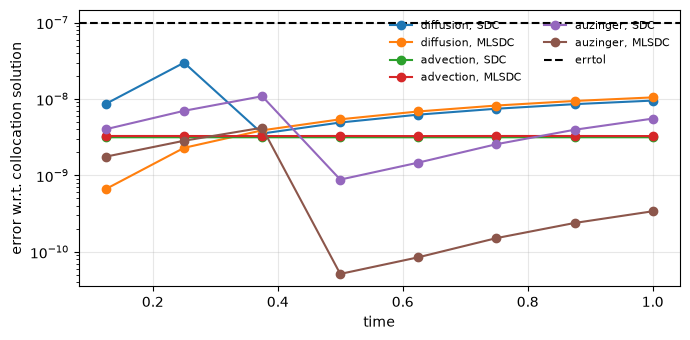
In every run and every step, the estimator stopped the iteration with the error below the tolerance, and without ever knowing the collocation solution. It stops earlier than the residual tolerance of \(10^{-10}\) alone would: without the estimator, the mean numbers of iterations are 7.88, 4.62, 5.00, 3.00, 7.50 and 4.50 instead. It is not overly cautious either: the errors end between about \(5 \cdot 10^{-11}\) and \(3 \cdot 10^{-8}\), below the tolerance of \(10^{-7}\) in every step.
Important things to note
The estimator can be used with several parallel steps, too. With the controller parameter
all_to_done, the estimate of the last step then decides when the whole block stops. It has seen little testing there, though.It is not available for the parallel
controller_MPIyet: as its name says,CheckIterationEstimatorNonMPIworks with the emulated parallelism ofcontroller_nonMPIonly.
The checks the tests run are inside run_simulations: the collocation error after every step, and the mean
number of iterations of each run.