

Part C: Studying collocation node types#
In Part B, the energy of the particle changed quite a bit in a single step. Here we test whether the collocation nodes are to blame, and on the way show how to set up a parameter study with pySDC: describe the whole setup except the parameter to vary, then loop over its values.
import matplotlib.pyplot as plt
import numpy as np

from pySDC.helpers.stats_helper import get_sorted
from pySDC.implementations.controller_classes.controller_nonMPI import controller_nonMPI
from pySDC.implementations.problem_classes.PenningTrap_3D import penningtrap
from pySDC.implementations.sweeper_classes.boris_2nd_order import boris_2nd_order
from pySDC.tutorial.step_3.HookClass_Particles import particle_hook

# initialize level parameters
level_params = {'restol': 1e-06, 'dt': 1.0 / 16}

# initialize sweeper parameters, the node type is set in the loop below
sweeper_params = {'num_nodes': 3}

# initialize problem parameters
problem_params = {
    'omega_E': 4.9,
    'omega_B': 25.0,
    'u0': np.array([[10, 0, 0], [100, 0, 100], [1], [1]], dtype=object),
    'nparts': 1,
    'sig': 0.1,
}

# initialize step parameters
step_params = {'maxiter': 20}

# initialize controller parameters
controller_params = {
    'hook_class': particle_hook,  # specialized hook class for more statistics and output
    'logger_level': 30,  # reduce verbosity of each run
}

# Fill description dictionary for easy hierarchy creation
description = {
    'problem_class': penningtrap,
    'problem_params': problem_params,
    'sweeper_class': boris_2nd_order,
    'level_params': level_params,
    'step_params': step_params,
}
The study#
For each node type we build a new controller. That is slightly inefficient, but it makes sure that all variables
and statistics start afresh. The stats of each run go into one dictionary, keyed by the node type.
# assemble and loop over list of collocation classes
quad_types = ['RADAU-RIGHT', 'GAUSS', 'LOBATTO']
stats_dict = {}
for qtype in quad_types:
    sweeper_params['quad_type'] = qtype
    description['sweeper_params'] = sweeper_params

    # instantiate the controller
    controller = controller_nonMPI(num_procs=1, controller_params=controller_params, description=description)

    # set time parameters
    t0 = 0.0
    Tend = level_params['dt']

    # get initial values on finest level
    P = controller.MS[0].levels[0].prob
    uinit = P.u_init()

    # call main function to get things done...
    uend, stats = controller.run(u0=uinit, t0=t0, Tend=Tend)

    # gather stats in dictionary, collocation classes being the keys
    stats_dict[qtype] = stats
sweeper - WARNING: we need to do a collocation update here, since the right end point is not a node. Changing this!
Then we compare the energy before and after the step, for each node type:
ediff = {}
for cclass, stats in stats_dict.items():
    # filter and convert/sort statistics by etot and iterations
    energy = get_sorted(stats, type='etot', sortby='iter')
    # compare base and final energy
    base_energy = energy[0][1]
    final_energy = energy[-1][1]
    ediff[cclass] = abs(base_energy - final_energy)
    print("Energy deviation for %s: %12.8e" % (cclass, ediff[cclass]))
Energy deviation for RADAU-RIGHT: 1.44960920e+01
Energy deviation for GAUSS: 2.33862957e-05
Energy deviation for LOBATTO: 9.32710464e-06
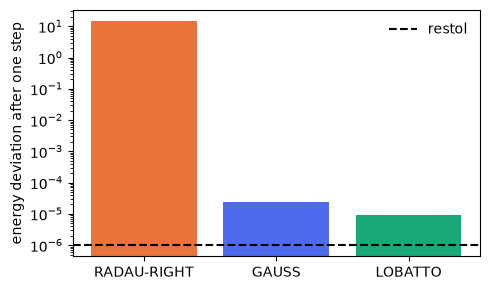
Gauss-Radau loses energy, Gauss-Legendre and Gauss-Lobatto hardly any, about \(10^{-5}\). The difference is symmetry. Both Gauss-Legendre and Gauss-Lobatto nodes are symmetric within the step, Gauss-Radau nodes are not.
Try it yourself
Lower the residual tolerance, e.g. to level_params['restol'] = 1e-10, and run the study again. What happens to
the energy deviation of each node type?
Answer
For the symmetric nodes it drops with the tolerance, to about \(6 \cdot 10^{-11}\) (Gauss) and \(8 \cdot 10^{-10}\) (Lobatto), at the price of a few more iterations. Rule of thumb: energy is conserved to within an order of magnitude or so of the residual tolerance. Gauss-Radau stays at 14.5 whatever the tolerance: its error is the one of the collocation method itself, not of the iteration. The checks below still pass.
Summary#
A parameter study: set up everything but the parameter, then loop, with a new controller for each value.
Working with several
statsdictionaries is not straightforward, but a meta-dictionary likestats_dicthelps. Alternatively, process eachstatsright after its run and keep only what you need.Symmetric collocation nodes conserve the energy of this problem to within an order of magnitude or so of the residual tolerance.
The checks the tests run:
# set expected differences and check
ediff_expect = {'RADAU-RIGHT': 15, 'LOBATTO': 1e-05, 'GAUSS': 3e-05}
for k, v in ediff.items():
    assert v < ediff_expect[k], f"ERROR: energy deviated too much, got {ediff[k]}"