

Part A: Multistep multilevel hierarchy#
For SDC and MLSDC, one step was all we needed. PFASST works on several time steps at once, and a controller
represents them simply as a list of steps, its attribute MS. The nice thing about going from MLSDC to PFASST is
that only one number changes: num_procs, the number of time steps the controller works on at once. This
controller only emulates working on them in parallel, see the box below; running them really in parallel takes the
MPI controller as well, with one process per step.
import matplotlib.pyplot as plt

from pySDC.implementations.controller_classes.controller_nonMPI import controller_nonMPI
from pySDC.implementations.problem_classes.HeatEquation_ND_FD import heatNd_forced
from pySDC.implementations.sweeper_classes.imex_1st_order import imex_1st_order
from pySDC.implementations.transfer_classes.TransferMesh import mesh_to_mesh

# initialize level parameters
level_params = {'restol': 1e-10, 'dt': 0.5}

# initialize sweeper parameters
sweeper_params = {'quad_type': 'RADAU-RIGHT', 'num_nodes': [3]}

# initialize problem parameters
problem_params = {
    'nu': 0.1,  # diffusion coefficient
    'freq': 4,  # frequency for the test value
    'nvars': [31, 15, 7],  # number of degrees of freedom for each level
    'bc': 'dirichlet-zero',  # boundary conditions
}

# initialize step parameters
step_params = {'maxiter': 20}

# initialize space transfer parameters
space_transfer_params = {'rorder': 2, 'iorder': 6}

# fill description dictionary for easy step instantiation
description = {
    'problem_class': heatNd_forced,  # pass problem class
    'problem_params': problem_params,  # pass problem parameters
    'sweeper_class': imex_1st_order,  # pass sweeper (see part B)
    'sweeper_params': sweeper_params,  # pass sweeper parameters
    'level_params': level_params,  # pass level parameters
    'step_params': step_params,  # pass step parameters
    'space_transfer_class': mesh_to_mesh,  # pass spatial transfer class
    'space_transfer_params': space_transfer_params,  # pass parameters for spatial transfer
}
The description is the one of an MLSDC run with three levels in space. The controller gets 10 processes:
# instantiate controller
controller = controller_nonMPI(num_procs=10, controller_params={}, description=description)
controller - INFO: Welcome to the one and only, really very astonishing and 87.3% bug free
                                 _____ _____   _____
                                / ____|  __ \ / ____|
                    _ __  _   _| (___ | |  | | |
                   | '_ \| | | |\___ \| |  | | |
                   | |_) | |_| |____) | |__| | |____
                   | .__/ \__, |_____/|_____/ \_____|
                   | |     __/ |
                   |_|    |___/
controller - INFO: Setup overview (--> user-defined, -> dependency) -- BEGIN
controller - INFO: ----------------------------------------------------------------------------------------------------

Controller: <class 'pySDC.implementations.controller_classes.controller_nonMPI.controller_nonMPI'>
    all_to_done = False
    dump_setup = True
    fname = run_pid4095.log
    hook_class = [<class 'pySDC.core.default_hook.DefaultHooks'>, <class 'pySDC.core.timings.CPUTimings'>]
    log_to_file = False
    logger_level = 20
    mssdc_jac = True
    predict_type = None
    use_iteration_estimator = False

Step: <class 'pySDC.core.step.Step'>
--> maxiter = 20
    Number of steps: None
    Level: <class 'pySDC.core.level.Level'>
        Level  0
-->         dt = 0.5
            dt_initial = 0.5
            nsweeps = 1
            residual_type = full_abs
-->         restol = 1e-10
-->         Problem: <class 'pySDC.implementations.problem_classes.HeatEquation_ND_FD.heatNd_forced'>
-->             bc = dirichlet-zero
-->             freq = (4,)
                liniter = 10000
                lintol = 1e-12
-->             nu = 0.1
-->             nvars = (31,)
                order = 2
                sigma = 0.06
                solver_type = direct
                stencil_type = center
 ->             Data type u: <class 'pySDC.implementations.datatype_classes.mesh.mesh'>
 ->             Data type f: <class 'pySDC.implementations.datatype_classes.mesh.imex_mesh'>
-->             Sweeper: <class 'pySDC.implementations.sweeper_classes.imex_1st_order.imex_1st_order'>
                    QE = EE
                    QI = IE
                    do_coll_update = False
                    initial_guess = spread
-->                 num_nodes = 3
-->                 quad_type = RADAU-RIGHT
                    skip_residual_computation = ()
 ->                 Collocation: <class 'pySDC.core.collocation.CollBase'>
        Level  1
-->         dt = 0.5
            dt_initial = 0.5
            nsweeps = 1
            residual_type = full_abs
-->         restol = 1e-10
-->         Problem: <class 'pySDC.implementations.problem_classes.HeatEquation_ND_FD.heatNd_forced'>
-->             bc = dirichlet-zero
-->             freq = (4,)
                liniter = 10000
                lintol = 1e-12
-->             nu = 0.1
-->             nvars = (15,)
                order = 2
                sigma = 0.06
                solver_type = direct
                stencil_type = center
 ->             Data type u: <class 'pySDC.implementations.datatype_classes.mesh.mesh'>
 ->             Data type f: <class 'pySDC.implementations.datatype_classes.mesh.imex_mesh'>
-->             Sweeper: <class 'pySDC.implementations.sweeper_classes.imex_1st_order.imex_1st_order'>
                    QE = EE
                    QI = IE
                    do_coll_update = False
                    initial_guess = spread
-->                 num_nodes = 3
-->                 quad_type = RADAU-RIGHT
                    skip_residual_computation = ()
 ->                 Collocation: <class 'pySDC.core.collocation.CollBase'>
        Level  2
-->         dt = 0.5
            dt_initial = 0.5
            nsweeps = 1
            residual_type = full_abs
-->         restol = 1e-10
-->         Problem: <class 'pySDC.implementations.problem_classes.HeatEquation_ND_FD.heatNd_forced'>
-->             bc = dirichlet-zero
-->             freq = (4,)
                liniter = 10000
                lintol = 1e-12
-->             nu = 0.1
-->             nvars = (7,)
                order = 2
                sigma = 0.06
                solver_type = direct
                stencil_type = center
 ->             Data type u: <class 'pySDC.implementations.datatype_classes.mesh.mesh'>
 ->             Data type f: <class 'pySDC.implementations.datatype_classes.mesh.imex_mesh'>
-->             Sweeper: <class 'pySDC.implementations.sweeper_classes.imex_1st_order.imex_1st_order'>
                    QE = EE
                    QI = IE
                    do_coll_update = False
                    initial_guess = spread
-->                 num_nodes = 3
-->                 quad_type = RADAU-RIGHT
                    skip_residual_computation = ()
 ->                 Collocation: <class 'pySDC.core.collocation.CollBase'>
        Base Transfer: <class 'pySDC.core.base_transfer.BaseTransfer'>
            finter = False
-->     Space Transfer: <class 'pySDC.implementations.transfer_classes.TransferMesh.mesh_to_mesh'>
            equidist_nested = True
-->         iorder = 6
            periodic = False
-->         rorder = 2

Active convergence controllers:
    |  # | order | convergence controller
----+----+-------+---------------------------------------------------------------------------------------
    |  0 |    95 | BasicRestartingNonMPI
 -> |  1 |   100 | SpreadStepSizesBlockwiseNonMPI
    |  2 |   200 | CheckConvergence
controller - INFO: ----------------------------------------------------------------------------------------------------
controller - INFO: Setup overview (--> user-defined, -> dependency) -- END
# check number of levels
for i in range(len(controller.MS)):
    print("Process %2i has %2i levels" % (i, len(controller.MS[i].levels)))
Process  0 has  3 levels
Process  1 has  3 levels
Process  2 has  3 levels
Process  3 has  3 levels
Process  4 has  3 levels
Process  5 has  3 levels
Process  6 has  3 levels
Process  7 has  3 levels
Process  8 has  3 levels
Process  9 has  3 levels
Ten steps, each a full hierarchy of its own, with its own levels, problems and sweepers:
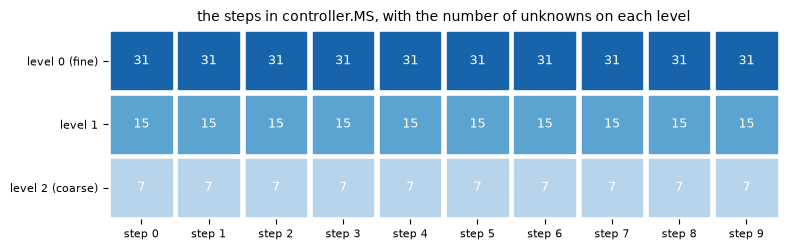
print('Step 0 and step 1 share their problem:', controller.MS[0].levels[0].prob is controller.MS[1].levels[0].prob)
Step 0 and step 1 share their problem: False
Important things to note
Controllers with the
_nonMPIsuffix only emulate parallelism, which saves the tedious installation of mpi4py and gives full access to all data at all times. The algorithm is the same, but the steps are computed serially: the controller moves all of them through the algorithm together, one stage at a time, and within each stage it handles one step after another. TheMPIcontrollers run them really in parallel and should give the same results, see Step 6.All steps of a controller are created from the same description, so they all have the same levels, as the check below confirms.
The check the tests run:
assert all(len(S.levels) == 3 for S in controller.MS), "ERROR: not all steps have the same number of levels"