

Part C: Advection and PFASST#
PFASST did very well for the heat equation in Part B. Now the same test for an
advection problem, \(u_t + c\, u_x = 0\) with periodic boundaries. The setup is the same, but with the fully
implicit sweeper generic_implicit, and with two preconditioners to compare: the LU-trick and implicit Euler.
The setup is periodic in time as well: at Tend = 1, the wave has travelled once through the domain, and the
exact solution looks exactly like the initial condition.
import matplotlib.pyplot as plt
import numpy as np

from pySDC.helpers.stats_helper import get_sorted
from pySDC.implementations.controller_classes.controller_nonMPI import controller_nonMPI
from pySDC.implementations.problem_classes.AdvectionEquation_ND_FD import advectionNd
from pySDC.implementations.sweeper_classes.generic_implicit import generic_implicit
from pySDC.implementations.transfer_classes.TransferMesh import mesh_to_mesh

# initialize level parameters
level_params = {'restol': 1e-09, 'dt': 0.0625}

# initialize sweeper parameters, the preconditioner QI is set in the loop below
sweeper_params = {'quad_type': 'RADAU-RIGHT', 'num_nodes': [3]}

# initialize problem parameters
problem_params = {
    'c': 1,  # advection coefficient
    'freq': 4,  # frequency for the test value
    'nvars': [128, 64],  # number of degrees of freedom for each level
    'order': 4,
    'bc': 'periodic',
    'stencil_type': 'center',
}

# initialize step parameters
step_params = {'maxiter': 50}

# initialize space transfer parameters
space_transfer_params = {'rorder': 2, 'iorder': 6, 'periodic': True}

# initialize controller parameters
controller_params = {'logger_level': 30, 'predict_type': 'pfasst_burnin'}

# fill description dictionary for easy step instantiation
description = {
    'problem_class': advectionNd,  # pass problem class
    'problem_params': problem_params,  # pass problem parameters
    'sweeper_class': generic_implicit,  # pass sweeper
    'level_params': level_params,  # pass level parameters
    'step_params': step_params,  # pass step parameters
    'space_transfer_class': mesh_to_mesh,  # pass spatial transfer class
    'space_transfer_params': space_transfer_params,  # pass parameters for spatial transfer
}

# set time parameters
t0 = 0.0
Tend = 1.0

# set up list of parallel time-steps to run PFASST with
nsteps = int(Tend / level_params['dt'])
num_proc_list = [2**i for i in range(int(np.log2(nsteps) + 1))]

# set up list of types of implicit SDC sweepers: LU and implicit Euler here
QI_list = ['LU', 'IE']
The runs#
As in Part B, for each preconditioner and each number of parallel steps:
results = {}
# loop over different types of implicit sweeper types
for QI in QI_list:
    # define and set preconditioner for the implicit sweeper
    sweeper_params['QI'] = QI
    description['sweeper_params'] = sweeper_params  # pass sweeper parameters

    # loop over different number of processes
    for num_proc in num_proc_list:
        print('Working with QI = %s on %2i processes...' % (QI, num_proc))
        # instantiate controller
        controller = controller_nonMPI(num_procs=num_proc, controller_params=controller_params, description=description)

        # get initial values on finest level
        P = controller.MS[0].levels[0].prob
        uinit = P.u_exact(t0)

        # call main function to get things done...
        uend, stats = controller.run(u0=uinit, t0=t0, Tend=Tend)

        # compute exact solution and compare
        uex = P.u_exact(Tend)
        err = abs(uex - uend)

        # filter statistics by type (number of iterations)
        iter_counts = get_sorted(stats, type='niter', sortby='time')

        # compute and print statistics
        niters = np.array([item[1] for item in iter_counts])
        print('   Mean number of iterations: %4.2f' % np.mean(niters))
        print('   Range of values for number of iterations: %2i ' % np.ptp(niters))
        print(
            '   Position of max/min number of iterations: %2i -- %2i' % (int(np.argmax(niters)), int(np.argmin(niters)))
        )
        print(
            '   Std and var for number of iterations: %4.2f -- %4.2f' % (float(np.std(niters)), float(np.var(niters)))
        )
        print()

        results[QI, num_proc] = (err, niters)

    means = [np.mean(results[QI, n][1]) for n in num_proc_list]
    print('Mean number of iterations went up from %4.2f to %4.2f for QI = %s!' % (min(means), max(means), QI))
    print()
    print()
Working with QI = LU on 1 processes...
   Mean number of iterations: 5.00
   Range of values for number of iterations:  0
   Position of max/min number of iterations:  0 --  0
   Std and var for number of iterations: 0.00 -- 0.00

Working with QI = LU on  2 processes...
   Mean number of iterations: 5.50
   Range of values for number of iterations:  1
   Position of max/min number of iterations:  1 --  0
   Std and var for number of iterations: 0.50 -- 0.25

Working with QI = LU on  4 processes...
   Mean number of iterations: 6.50
   Range of values for number of iterations:  3
   Position of max/min number of iterations:  3 --  0
   Std and var for number of iterations: 1.12 -- 1.25

Working with QI = LU on  8 processes...
   Mean number of iterations: 8.94
   Range of values for number of iterations:  9
   Position of max/min number of iterations:  7 --  0
   Std and var for number of iterations: 2.82 -- 7.93

Working with QI = LU on 16 processes...
   Mean number of iterations: 14.75
   Range of values for number of iterations: 21
   Position of max/min number of iterations: 15 --  0
   Std and var for number of iterations: 6.59 -- 43.44

Mean number of iterations went up from 5.00 to 14.75 for QI = LU!


Working with QI = IE on  1 processes...
   Mean number of iterations: 5.00
   Range of values for number of iterations:  0
   Position of max/min number of iterations:  0 --  0
   Std and var for number of iterations: 0.00 -- 0.00

Working with QI = IE on  2 processes...
   Mean number of iterations: 5.50
   Range of values for number of iterations:  1
   Position of max/min number of iterations:  1 --  0
   Std and var for number of iterations: 0.50 -- 0.25

Working with QI = IE on  4 processes...
   Mean number of iterations: 6.50
   Range of values for number of iterations:  3
   Position of max/min number of iterations:  3 --  0
   Std and var for number of iterations: 1.12 -- 1.25

Working with QI = IE on  8 processes...
   Mean number of iterations: 8.50
   Range of values for number of iterations:  7
   Position of max/min number of iterations:  7 --  0
   Std and var for number of iterations: 2.29 -- 5.25

Working with QI = IE on 16 processes...
   Mean number of iterations: 13.19
   Range of values for number of iterations: 17
   Position of max/min number of iterations: 15 --  0
   Std and var for number of iterations: 5.32 -- 28.28

Mean number of iterations went up from 5.00 to 13.19 for QI = IE!
<matplotlib.colorbar.Colorbar at 0x7f42c4cb0830>
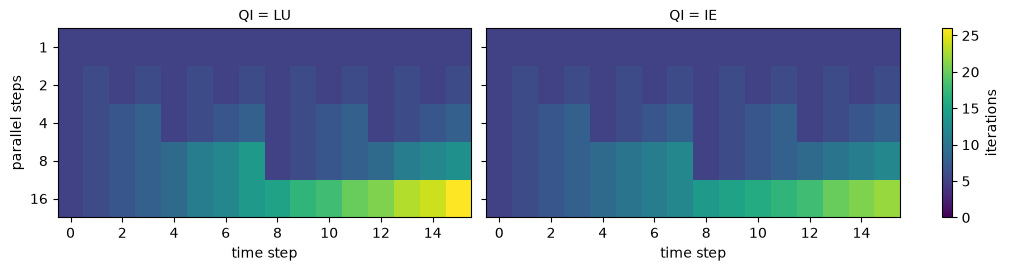
Unlike for the heat equation, the iteration counts grow significantly with the number of parallel steps, and within each block of parallel steps the later ones need more. How much depends on the problem, but this is typical for parallel-in-time methods of this kind. Note also that the LU-trick, so good for the heat equation, is no better than implicit Euler here, and even slightly worse with 8 and 16 parallel steps.
Try it yourself
Add 'MIN-SR-S' to QI_list: a diagonal preconditioner, whose nodes could be solved in parallel. How does it
fare with 16 parallel steps?
Answer
Much worse: about 24 iterations per step on average, against 15 for 'LU' and 13 for 'IE'. With one step at a
time, all three need 5. With 16 parallel steps, the last four hit maxiter = 50 without reaching restol, so its
error, \(5.2 \cdot 10^{-4}\), is above what the check in the last cell allows. All converged runs end at the same
error, set by the spatial discretization, just below that threshold.
Important things to note
Like the IMEX sweeper,
generic_implicitlets you choose the preconditioner withQI:'IE'for implicit Euler,'LU'for the LU-trick, and more. They come from the qmat package, andqmat.qdelta.QDELTA_GENERATORSlists them all, implicit and explicit ones.
The check the tests run, for every run:
for err, _ in results.values():
    assert err < 5.1365e-04, f"ERROR: error is too high, got {err}"