

Part B: My first sweeper#
Now we run SDC for one time step, by hand. The problem is the heat equation with a forcing term,
heatNd_forced, and the sweeper imex_1st_order treats the two parts differently: diffusion implicitly,
forcing explicitly. This is IMEX SDC, and it needs the right-hand side in two parts, which the data type
imex_mesh provides as .impl and .expl.
Note
Again, this is for demonstration only. Users normally let a controller do all of this, see Part C.
import matplotlib.pyplot as plt

from pySDC.core.step import Step
from pySDC.implementations.problem_classes.HeatEquation_ND_FD import heatNd_forced
from pySDC.implementations.sweeper_classes.imex_1st_order import imex_1st_order

# initialize level parameters
level_params = {'restol': 1e-10, 'dt': 0.1}

# initialize sweeper parameters
sweeper_params = {'quad_type': 'RADAU-RIGHT', 'num_nodes': 3}

# initialize problem parameters
problem_params = {
    'nu': 0.1,  # diffusion coefficient
    'freq': 4,  # frequency for the test value
    'nvars': 1023,  # number of degrees of freedom
    'bc': 'dirichlet-zero',  # boundary conditions
}

# initialize step parameters
step_params = {'maxiter': 20}

# Fill description dictionary for easy hierarchy creation
description = {
    'problem_class': heatNd_forced,
    'problem_params': problem_params,
    'sweeper_class': imex_1st_order,
    'sweeper_params': sweeper_params,
    'level_params': level_params,
    'step_params': step_params,
}

# instantiate the step we are going to work on, and make shortcuts for the level and the problem
S = Step(description=description)
L = S.levels[0]
P = L.prob
Parameters and status#
Steps and levels carry two kinds of attributes. Parameters are what we asked for in the description, such as
S.params.maxiter or L.params.restol. The status reflects where the computation currently is, such as
S.status.iter, L.status.time or L.status.residual. We set the status of the level to the start of the step
and put the initial value at index 0:
# set initial time in the status of the level
L.status.time = 0.1
# compute initial value (using the exact function here)
L.u[0] = P.u_exact(L.time)
Predict, sweep, check#
The sweeper does the actual work, with three routines. predict fills the nodes with a first guess; without it,
they stay empty. compute_residual measures how far the values at the nodes are from solving the collocation
problem. update_nodes is one SDC sweep.
# access the sweeper's predict routine to get things started
L.sweep.predict()
# compute the residual (we may be done already!)
L.sweep.compute_residual()

print(f'right-hand side at node 1: {type(L.f[1]).__name__} with parts .impl and .expl')
print(f'residual of the initial guess: {L.status.residual:12.8e}')
right-hand side at node 1: imex_mesh with parts .impl and .expl
residual of the initial guess: 2.54112696e-02
Now we sweep until the residual is below restol or we run out of iterations:
# reset iteration counter
S.status.iter = 0
residuals = [L.status.residual]
# run the SDC iteration until either the maximum number of iterations is reached or the residual is small enough
while S.status.iter < S.params.maxiter and L.status.residual > L.params.restol:
    # this is where the nodes are actually updated according to the SDC formulas
    L.sweep.update_nodes()
    # compute/update the residual
    L.sweep.compute_residual()
    # increment the iteration counter
    S.status.iter += 1
    residuals.append(L.status.residual)
    print(
        f'Time {L.time:4.2f} of {L.level_index} -- Iteration: {S.status.iter:2d} -- Residual: {L.status.residual:12.8e}'
    )
Time 0.10 of 0 -- Iteration:  1 -- Residual: 4.11190756e-03
Time 0.10 of 0 -- Iteration:  2 -- Residual: 6.68442665e-04
Time 0.10 of 0 -- Iteration:  3 -- Residual: 8.80377582e-05
Time 0.10 of 0 -- Iteration:  4 -- Residual: 1.21707909e-05
Time 0.10 of 0 -- Iteration:  5 -- Residual: 1.38271970e-06
Time 0.10 of 0 -- Iteration:  6 -- Residual: 6.36446134e-07
Time 0.10 of 0 -- Iteration:  7 -- Residual: 1.68953336e-07
Time 0.10 of 0 -- Iteration:  8 -- Residual: 3.52588866e-08
Time 0.10 of 0 -- Iteration:  9 -- Residual: 6.07224706e-09
Time 0.10 of 0 -- Iteration: 10 -- Residual: 8.27159898e-10
Time 0.10 of 0 -- Iteration: 11 -- Residual: 1.19139256e-10
Time 0.10 of 0 -- Iteration: 12 -- Residual: 1.44547065e-11
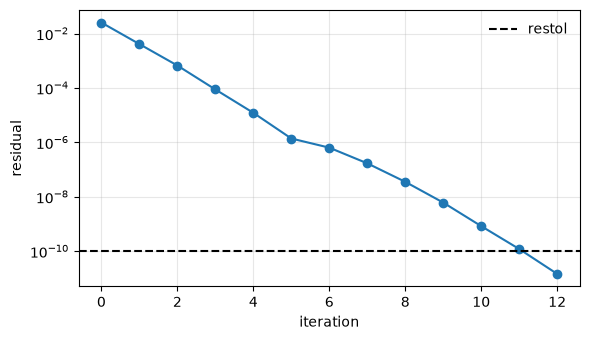
Most sweeps reduce the residual by a factor of five to ten, with a slower patch around the sixth. Once converged, the values at the nodes solve a collocation problem like the one in Step 1, Part C, without ever assembling it.
Finishing the step#
The solution at the end of the step is computed from the values at the nodes by compute_end_point, and only
there. Then the time moves on and we compare with the exact solution:
# compute the interval's endpoint: this (and only this) will set uend, depending on the collocation nodes
L.sweep.compute_end_point()
# update the simulation time
L.status.time += L.dt

# compute exact solution and compare
err = abs(P.u_exact(L.status.time) - L.uend)
res, niter = L.status.residual, S.status.iter
print(f'Error and residual: {err:12.8e} -- {res:12.8e}')
Error and residual: 9.84422769e-06 -- 1.44547065e-11
Try it yourself
The sweeper preconditions each sweep with a lower-triangular matrix \(Q_\Delta\), chosen with the sweeper parameter
QI. The default is 'IE' (implicit Euler). Set sweeper_params['QI'] = 'LU' in the first cell, or
'MIN-SR-S', and run everything again. How many iterations do you need now?
Answer
'LU' needs 10 iterations instead of 12, 'MIN-SR-S' needs 11. The error stays the same: all of them converge
to the same collocation solution, only the path differs. 'MIN-SR-S' is diagonal, so its nodes could be solved in
parallel, which is what the project parallel SDC is about.
Summary#
One SDC step is: set the initial value,
predict, thenupdate_nodesandcompute_residualuntil converged, thencompute_end_point.Parameters are what you asked for; status is where the computation is.
This logic is simple but tedious, and it gets much worse with several steps, levels or processes. Hence Part C.
The checks the tests run:
assert err <= 1e-5, f"ERROR: IMEX SDC iteration did not reduce the error enough, got {err}"
assert res <= level_params['restol'], f"ERROR: IMEX SDC iteration did not reduce the residual enough, got {res}"
assert niter <= 12, f"ERROR: IMEX SDC took too many iterations, got {niter}"