

Soft faults in SDC#
In this project, we inject bit flips into SDC sweeps, detect them and repeat the affected part of the sweep. Unlike a crash, such a soft fault does not stop the run; it silently changes a number, which the iteration may or may not recover from.
Injecting, detecting and correcting faults#
implicit_sweeper_faults.py is a generic_implicit sweeper that can do all three:
Injection: in one iteration per run, chosen at random, the sweeper flips a random bit (mantissa, exponent or sign) of a random entry of either the solution or the right-hand side at a random collocation node. The hook in
FaultHooks.pypicks the iteration, below the number of iterations the run needs without faults.Detection: after each implicit solve, the sweeper computes the residual of that solve. If its maximum norm is larger than
detector_threshold, or not a number, a fault is detected.Correction: with
allow_fault_correction, the sweeper then repeats the solve at that node, once.
The sweeper counts detected and missed faults, false positives, and false positives during a correction.
Statistics for the van der Pol oscillator#
generate_statistics.py runs one time step of the van der Pol oscillator with \(\mu = 18\) without faults, to
get the number of iterations, and then 500 times with faults.
It writes the detector’s true and false positives and negatives, its F-score, precision, true and false positive rates
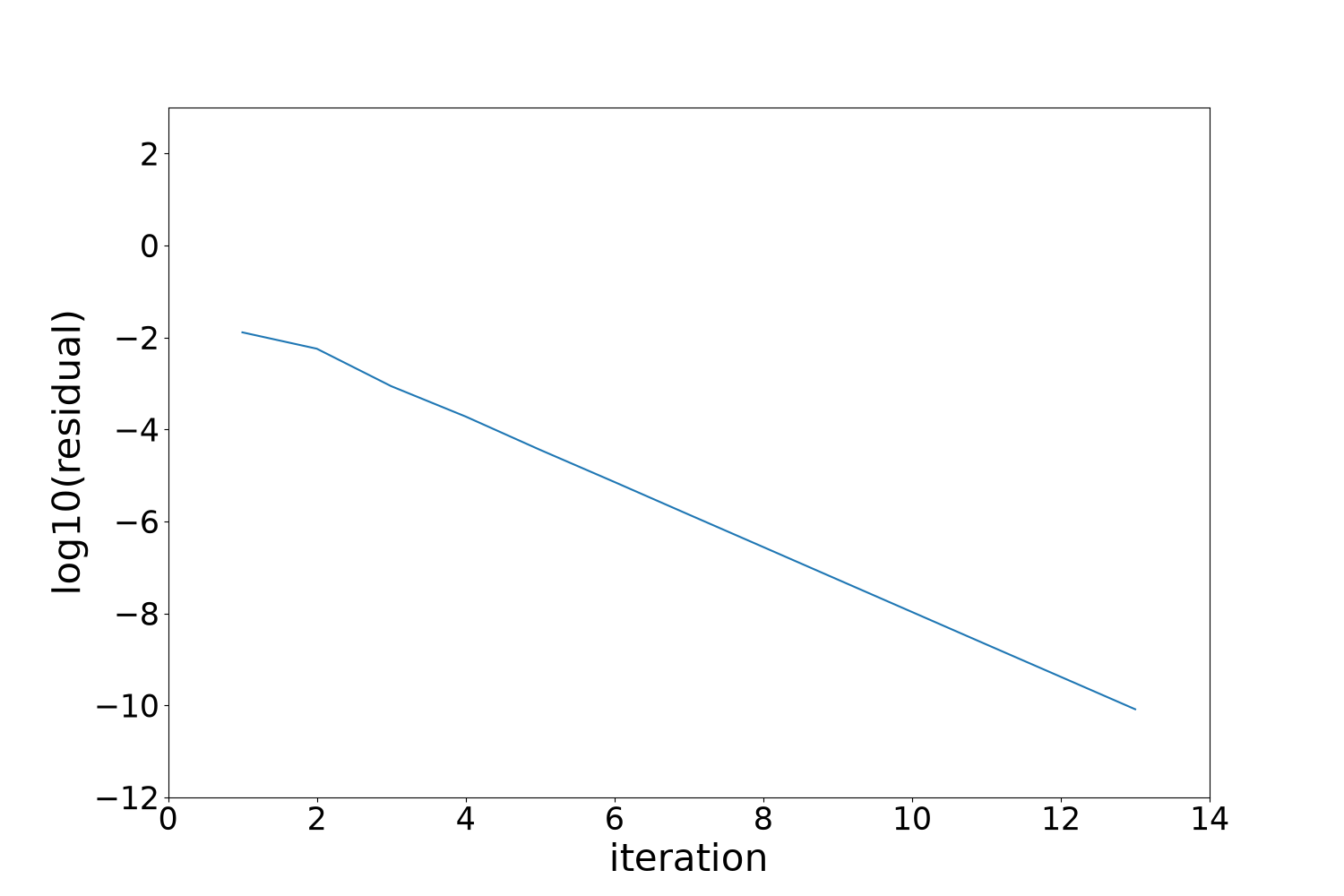
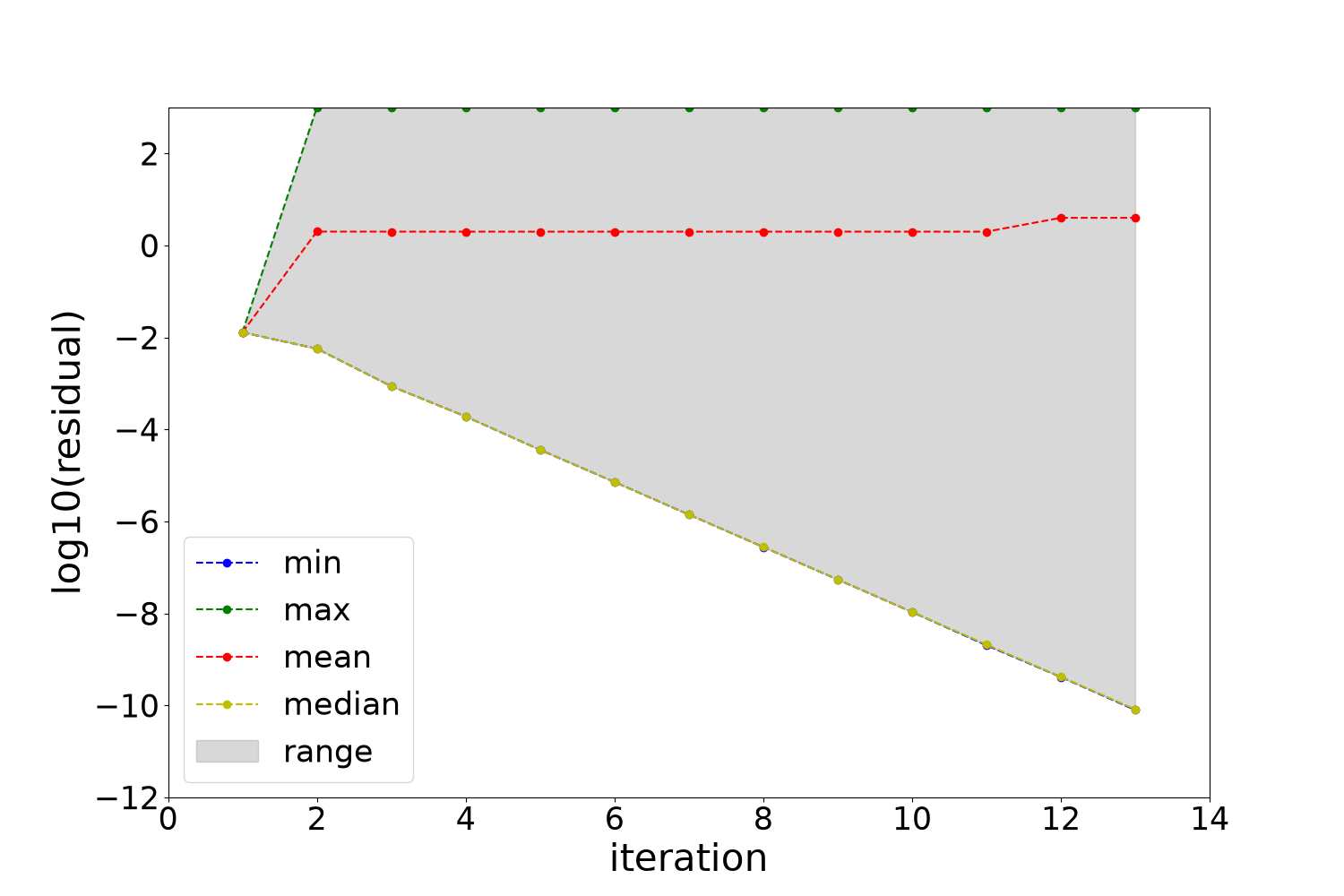
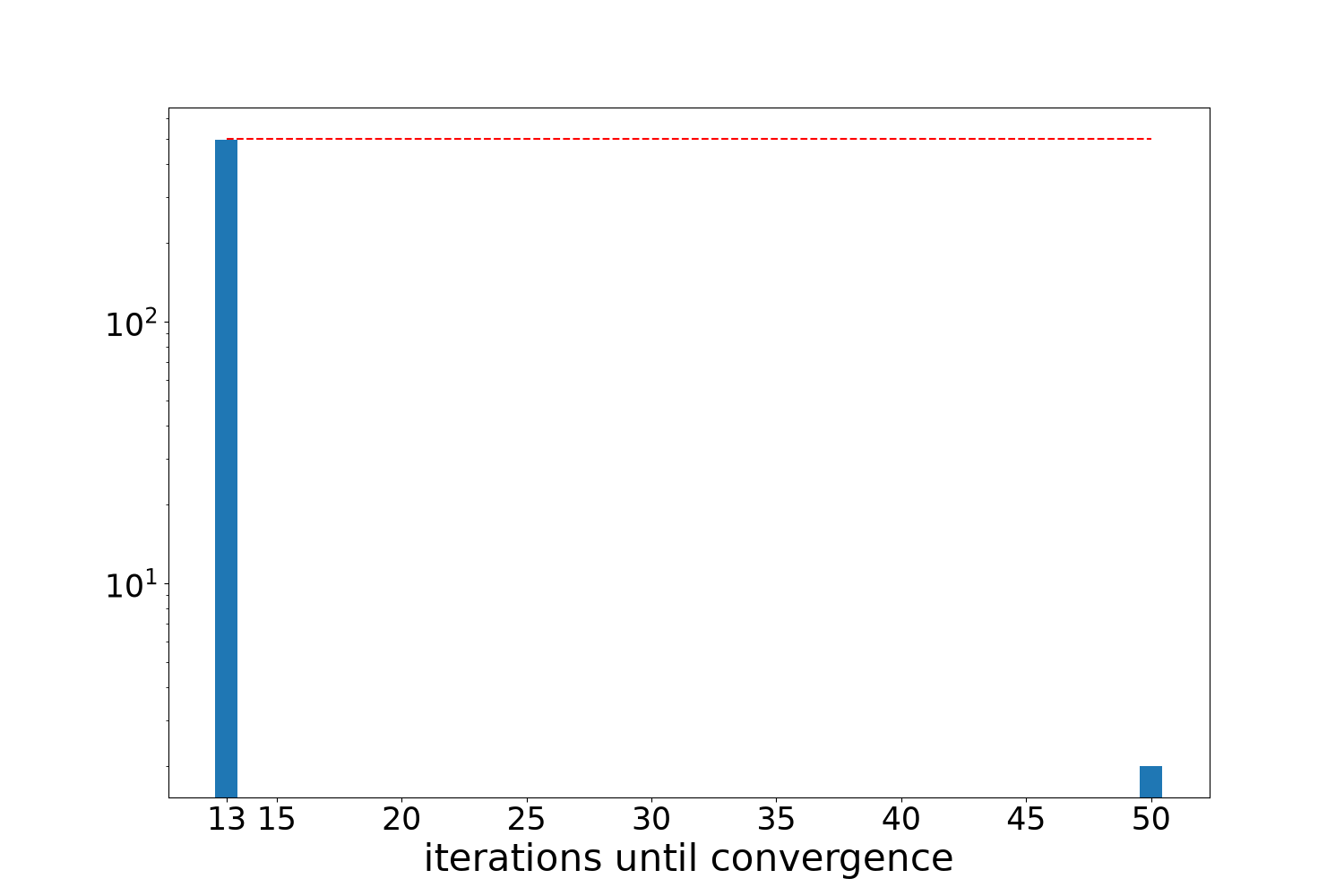
(after Sloan, Kumar and Bronevetsky, 2012) into data/vanderpol_500_runs_Statistics.txt, and plots the residual of
the last run, the smallest, largest, mean and median residual over all runs, and a histogram of the number of
iterations:
The same file has setups for the heat equation (diffusion_setup) and the generalized Fisher equation
(reaction_setup), which main does not run.
Tests#
The test runs generate_statistics.py; the plots above are made by the CI, from the current code.